For exhibitors
Practical information
What is included in the stand rental?
“Raw” floor space is sold. All stands at Copenhagen Bike Show are sold as “raw” floor space. The floor is a rustic concrete floor with a patina that stands in perfect contrast to the modern and brand new models on display. Additional services such as carpets, walls and furniture must be ordered and paid for through our partner.
Practical information
- Set up on Friday, March 5, 2027 between 8 am – 10 pm
- Dismantling on Sunday, March 7, 2027 between 4 am – 10 pm
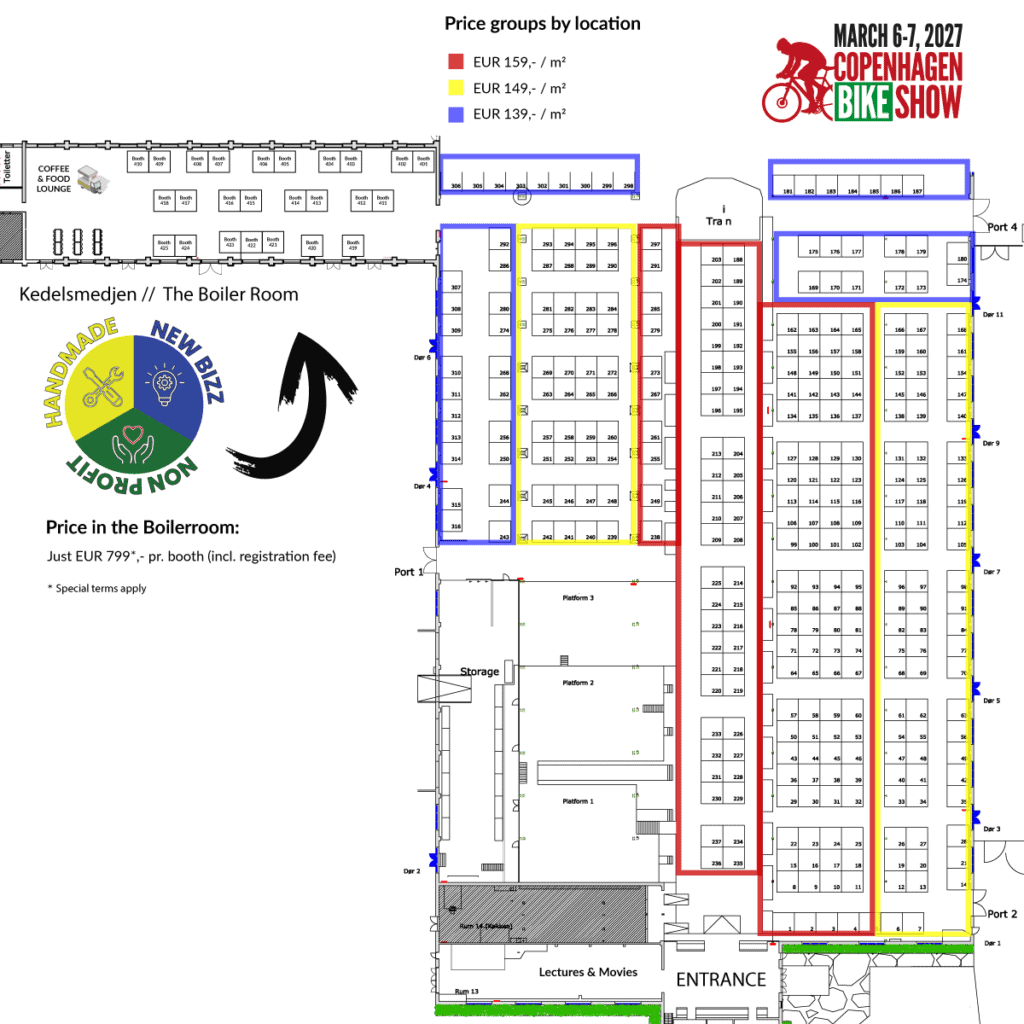
- BLUE ZONEEUR / m²139,-
- Space in blue zone
- Space in online catalog
- Space in outdoor test area
- Price per m²
- Price excluding fees and VAT
- RED ZONEEUR / m²159,-
- Space in red zone
- Space in online catalog
- Space in outdoor test area
- Price per m²
- Price excluding fees and VAT
- YELLOW ZONEEUR / m²149,-
- Space in yellow zone
- Space in online catalog
- Space in outdoor test area
- Price per m²
- Price excluding fees and VAT
In addition to the stand rental, a registration fee of EUR 299,- (DKK 2,245) excl. VAT will be charged. This covers power outlet, electricity consumption, administration and marketing.
Stands in Kedelsmedjen (The Boiler Room), and Walk & Talk spaces are exempt from this fee.
Target groups
The serious exerciser
The majority of our visitors can be described as serious exercisers.
It is a group of primarily men who spend a lot of time and money on their greatest passion: Cycling.
Many from this group have more than one bike, and the collection often consists of a racing bike, as well as gravel and/or MTB.
Among the visitors in this target group, 74% are men, and they come from all over the country – as well as southern Sweden – to participate in the fair.
The age group is 35-70 years.
38% of visitors to the fair describe themselves as serious exercisers (survey from 2022).
The willingness to pay is high in this group, which is characterized by people with good finances, who live a healthy and active life, and like to spend money on themselves and their hobbies.
The dedicated commuter
A large number of our visitors use their bicycles for more than just exercise and enjoyment.
They are what you might call dedicated commuters.
One third of all commuter trips in the capital region are made by bicycle, and studies show that half of all commuters in Denmark could take their (electric) bicycle to work.
There is thus huge potential to get even more people to cycle to and from work, education, etc.
Among the visitors in this target group, 67% are men, and they primarily come from the Capital Region, Zealand and Southern Sweden to participate in the fair.
The age group is 25-55 years.
18% of visitors to the fair describe themselves as dedicated commuters (2022 survey).
The willingness to pay is quite high in this group, and increases with age, as bicycles and equipment are crucial elements for the group’s transportation choices.
Physical well-being and focus on climate and environment are important parameters for this group.
The busy family with children
Many families with children in larger Danish cities are increasingly opting out of cars, or at least second cars.
The challenges of finding a parking space, as well as the growing costs of electricity or fuel, make the (e)bike – and especially the (e)cargo bike – an obvious alternative that more and more people are using.
Among the visitors in this target group, 62% are women and they primarily come from the Capital Region, as well as larger urban areas on Zealand and southern Sweden.
The age group is 25-40 years.
19% of visitors to the fair describe themselves as belonging to this category (2022 survey).
The willingness to pay for this group varies somewhat, but can be described as medium to high.
Practical considerations that should make everyday life in cities easier, as well as a focus on quality time with your children, are important parameters for this group.
The active senior
A smaller, but growing, proportion of the fair’s visitors can be described as active seniors.
They are characterized by being in better physical and mental shape than previous generations, and they enjoy being active on (electric) bicycles.
Visitors in this target group typically come to the fair as married couples, or with family and friends. They are typically from the Capital Region, Zealand and to a lesser extent from southern Sweden.
Aldersgruppen er ca. 65 år og ældre.
8% af de besøgende på messen betegner sig selv som aktive seniorer (undersøgelse fra 2022).
Betalingsvilligheden er ganske stor i denne gruppe, da elcykler i god kvalitet, samt relevant sikkerhedsudstyr, er vigtige for gruppen.
Many seniors have quite good finances and want to spend money on pampering themselves.
The adventurous bicycle tourist
Cycling experiences are something that more and more people are discovering. It can be exercise bike races, exploring beautiful landscapes, cycling trips at home or abroad, etc.
Many from the target group “The serious exerciser” can also be found in this group, which also includes families with children looking for ideas for a summer holiday by bike, or seniors who want to explore new parts of Denmark or abroad. Typically on an electric bike.
Among the visitors in this target group, approximately 70% are men, and they come from all over the country – as well as southern Sweden – to participate in the fair.
The age group is 35-70 years.
11% of visitors to the fair are from this category (survey from 2022).
The willingness to pay is high in this group, who focus on a healthy and active life and are happy to spend money on themselves and their hobbies.
Copenhagen Bike Show in numbers
Visitors in 2026
Increase from 2025
B2B guests in 2026
That's what visitors come for

About the room
The locomotive workshop is DSB’s old workshop for the steam locomotives of the time, and is used today for modern and stylish events, such as a beer festival, fashion shows, conferences and much more.
Med den centrale beliggenhed tæt på Dybbølsbro Station i Sydhavnen, samt de gode parkeringsmuligheder, er det nemt at komme til på cykel, til fods og i bil.
The construction of the many workshops began in 1907, when rail traffic had become a central traffic artery in Denmark. The central workshop was responsible for overhauling the steam locomotives of the time at intervals of 2 to 4 years. During the most extensive overhauls, all the locomotive’s components were disassembled and checked in the many different workshops. A major overhaul could take up to 8 months.
The majority of the employees at the Central Workshop were civil servants. In 1945 there were around 1,400 employees.